Neverwinter
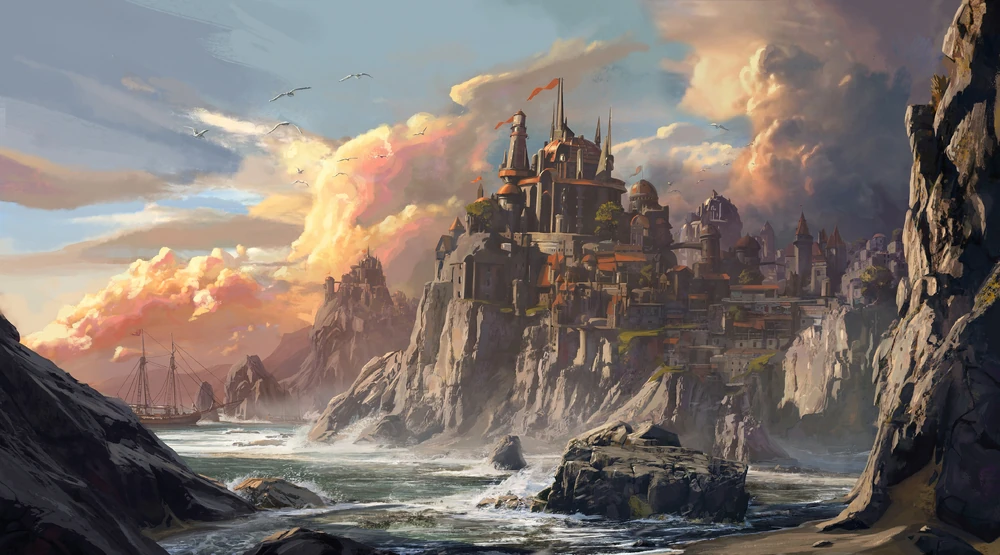
Neverwinter—the Jewel of the North—is more than a city. It is a symbol of resilience, a masterpiece of craftsmanship, and the beating heart of civilization along the northern Sword Coast. It is also a political player in a region of rival city-states, ancient grudges, and fragile alliances.
To understand Neverwinter is to understand the hope, tragedy, stubborn will, and calculated diplomacy that defines the North itself.
The City of Skilled Hands
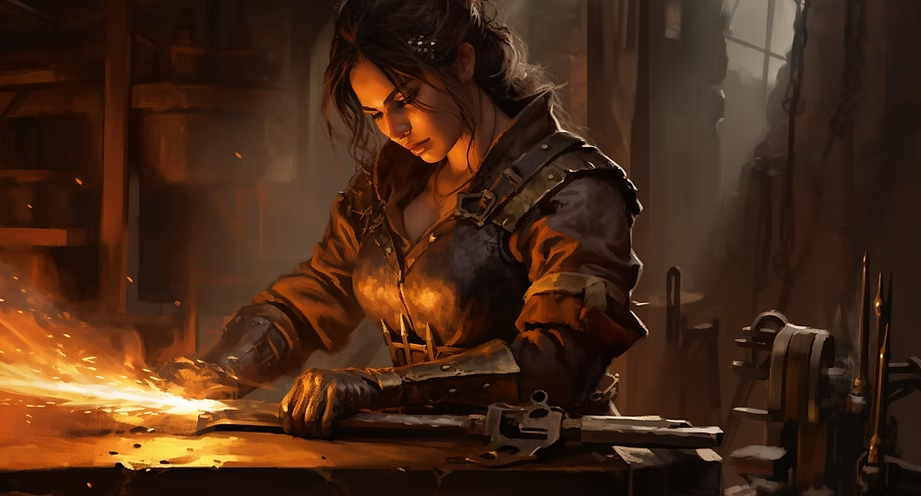
Neverwinter is renowned across Faerûn for the extraordinary skill of its artisans.
- Clockwork and Craft: Neverwinter’s clocks keep perfect time. Its blades never rust. Its jewelry is sought by nobles from Waterdeep to Silverymoon.
- The River That Never Freezes: The Neverwinter River runs warm year-round, heated by the volcanic fires of Mount Hotenow. This natural wonder allows the city’s famous bridges to remain ice-free and its gardens to bloom even in deep winter.
- Aesthetic Splendor: Before the Ruining, the city was a work of art—graceful towers, enchanted streetlamps, and public gardens that seemed plucked from a fairy tale.
This reputation for beauty and quality earned it the title Jewel of the North—a title it still claims, even as it rises again from ashes.
Institutes of Note
Neverwinter has always been more than a city of craftsmen and soldiers. At its height, it was a center of learning—home to institutions that drew scholars, mages, and students from across the North.
🎓 The Neverwinter Academy
The crown jewel of the city’s intellectual life, the Neverwinter Academy was one of the most respected centers of learning on the Sword Coast. More than a wizards’ college, it was a full institution—training scholars, diplomats, soldiers, and mages alike under one roof.
The Academy was devastated by the Ruining of 1451 DR and spent decades as a ruin within a ruined city. Its restoration is one of Lord Neverember’s most visible and politically calculated projects—a symbol that Neverwinter is not merely rebuilding its walls, but reclaiming its soul.
Neverwinter’s Political Web
Neverwinter does not exist in isolation. Its fate is tied to a network of alliances, rivalries, and cold wars with its neighbors.
Map
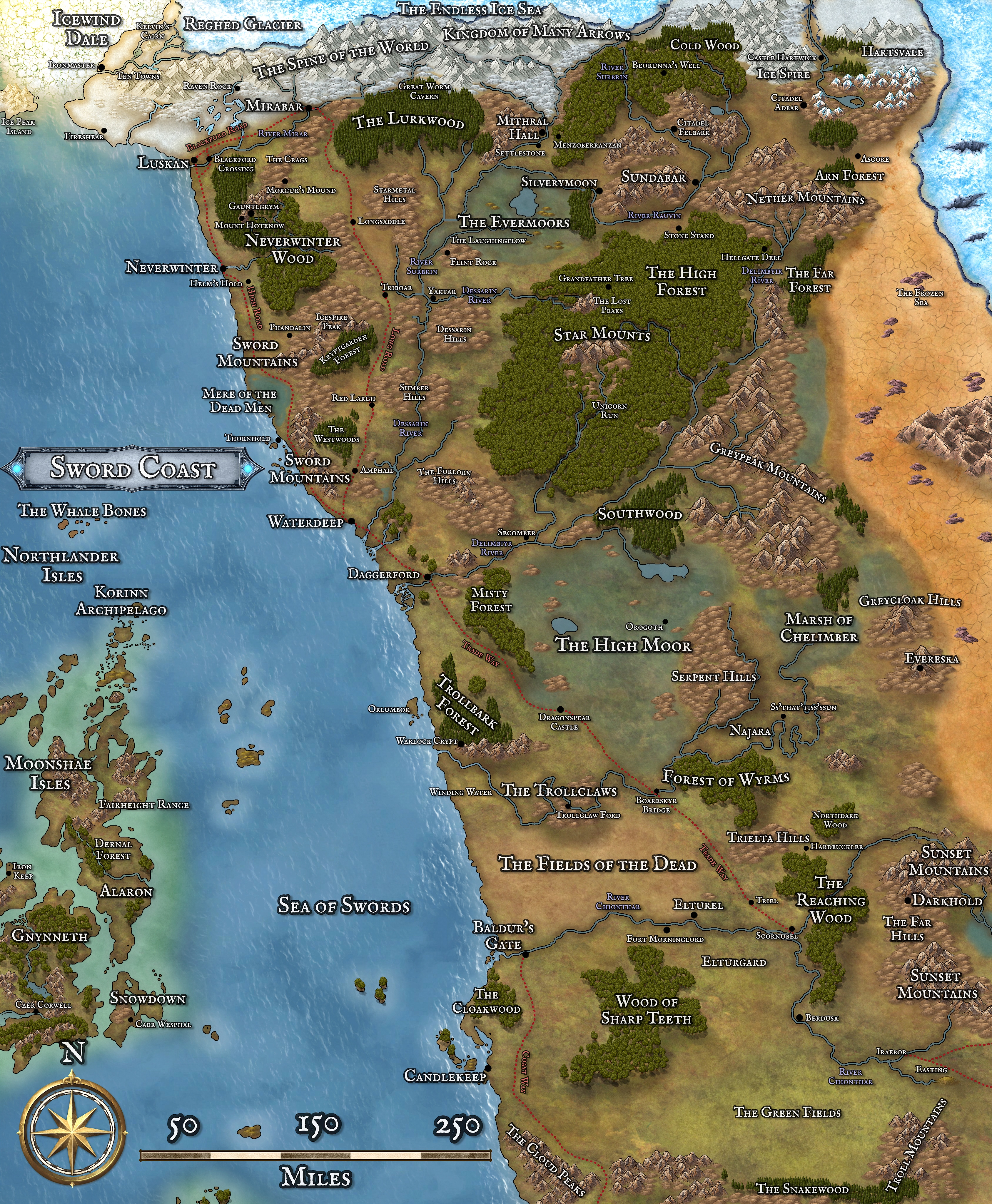
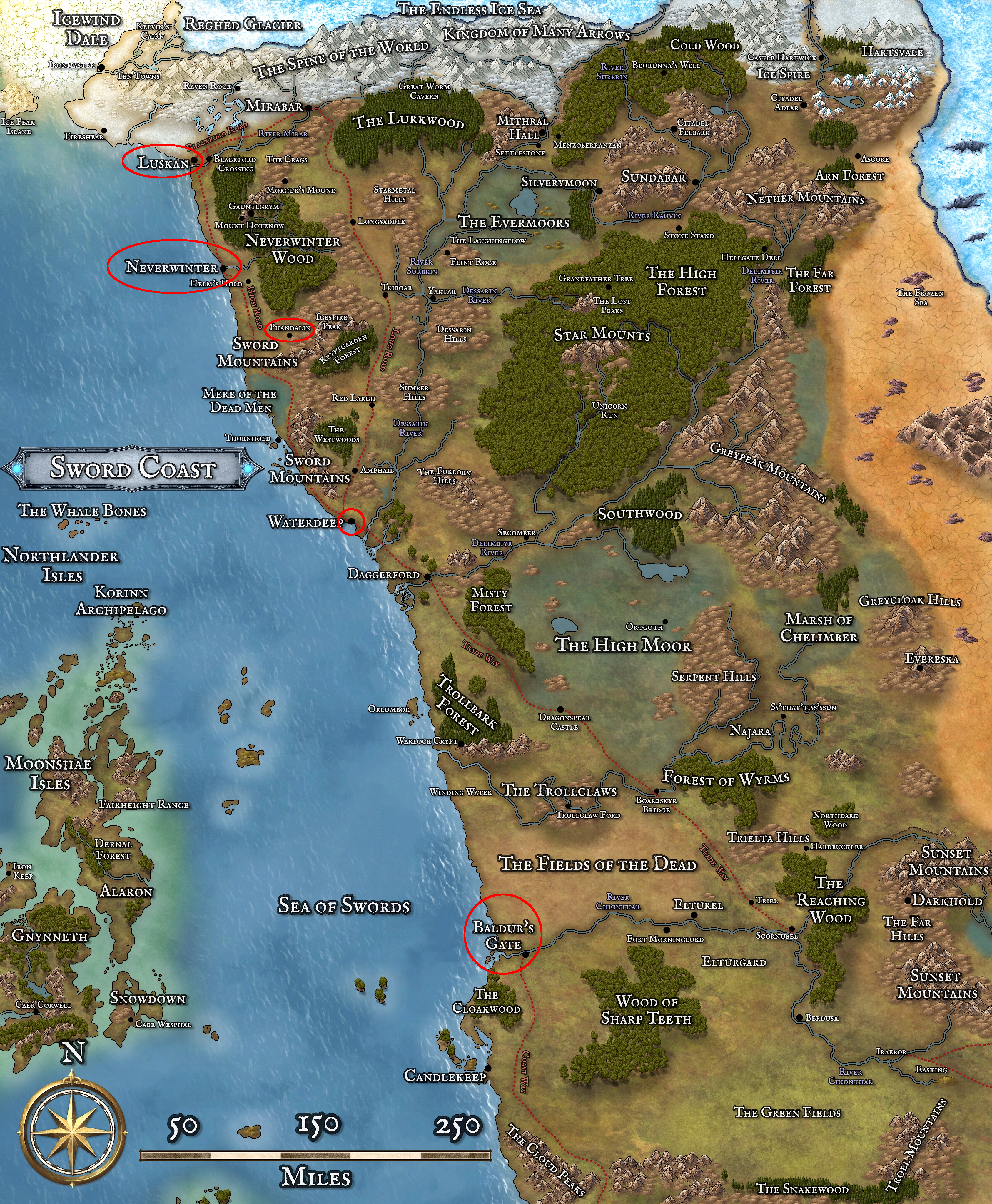
For the sake of referencing where each town is, I’ve included two maps. A plain map and a marked map displaying places of interest.
Unmarked
Marked
🏙️ With Luskan: The Ancient Rival
Neverwinter’s relationship with Luskan is its oldest and most bitter. The “City of Sails” represents everything Neverwinter is not: a haven for pirates, smugglers, and cutthroat mercantilism. This clash of cultures has fueled centuries of economic competition, espionage, and open war.
The War of the Wailing Death (1372 DR): Relations hit their lowest point following the Wailing Death plague. With Neverwinter reeling from massive casualties, Luskan declared war and invaded. Though Neverwinter’s defenders ultimately repelled the attack, the betrayal during a moment of profound weakness is a searing memory passed down through generations.
A Permanent Cold War: In the centuries that followed, the two cities existed in a state of guarded hostility. Neverwinter’s Lord Nasher went so far as to forbid the creation of city maps to thwart Luskan spies. While the utter destruction of the Ruining (1451 DR) paused major conflict, the underlying disdain and rivalry never faded.
Current Stance: With Neverwinter rebuilding, old suspicions are resurfacing. Luskan views Neverwinter’s resurgence as a threat to its influence in the North, while Neverwinter watches its old rival, waiting for the next move.
🏛️ With Waterdeep: The Ambiguous Patron
Neverwinter’s relationship with Waterdeep is complex, layered with genuine gratitude, deep financial obligation, and simmering political resentment.
The Savior Complex: Following the Ruining of 1451 DR, it was Lord Dagult Neverember, the Open Lord of Waterdeep, who personally financed and organized Neverwinter’s rebirth. His Neverwinter Resettlement Charter of 1467 DR provided the funds and security to begin the monumental task of rebuilding. While Neverwintans are grateful for the city’s survival, many are resentful that their fate was held in the hands of an outsider’s wealth and ambition.
A Relationship of Debt: Neverwinter’s reconstruction was bankrolled by Waterdhavian gold, creating a profound and lasting debt. This debt is not merely financial; it is political. Waterdeep expects loyalty, favorable trade concessions, and a degree of influence over northern affairs in return for its investment.
The Neverember Problem: Lord Dagult Neverember’s rule is the embodiment of this tension. He arrived from Waterdeep and appointed himself Lord Protector of Neverwinter while still serving as its Open Lord. For decades (1467–1489 DR), he ruled both cities, leading many Neverwintans to view him as a Waterdhavian governor in Neverwinter clothing. Though he was ousted from Waterdeep in 1489 DR and his focus is now solely on Neverwinter, his legacy is permanently intertwined with Waterdeep’s patronage, a fact that continues to color the cities’ relationship.
⚔️ With the Lord’s Alliance: Membership Under Scrutiny
As a key northern city-state, Neverwinter is a founding and influential member of the Lord’s Alliance. This coalition of rulers exists to secure trade and mutual defense, and Neverwinter has historically been one of its most stalwart northern enforcers.
A Pillar of the North: For centuries, Neverwinter’s strength and stability made it a cornerstone of the Alliance’s power in the region, acting as a bulwark against threats from the wilderness, Luskan, and the remnants of the orcish Kingdom of Many-Arrows.
A Weakened Position: The city’s near-total destruction in 1451 DR and its subsequent struggle to rebuild have damaged its standing. While it retains its seat, some among the Alliance’s southern members question its current strength and ability to fulfill its old role, viewing its leadership as distracted by internal recovery.
Current Stance: Lord Neverember uses the Alliance to legitimize his rule and check Luskan’s influence. Neverwinter’s relationship with the Alliance is one of conditional support—it relies on the coalition for political backing but must continually prove it remains an asset, not a liability.
🛡️ With the Frontier (Phandalin & Beyond): The Reluctant Guardian
Neverwinter’s relationship with the frontier settlements it claims to protect is defined by practical neglect. Towns like Phandalin are seen as assets for resources and as a buffer zone against the wilds, but they are rarely a priority for the city’s limited resources.
A Legacy of Abandonment: Many of these settlements were originally founded or supported by Neverwinter, only to be abandoned during the Orc Wars or the chaos following the Ruining. This history has bred a deep-seated independence and a justified skepticism of Neverwinter’s promises among frontier folk.
The Adventurer Pipeline: Unable or unwilling to commit its own soldiers, Neverwinter’s government often responds to frontier problems by hiring or encouraging adventurers. This turns freelance problem-solvers into the de facto enforcement and protection for these communities.
Current Stance: Neverwinter offers symbolic oversight and vague promises of future aid to settlements like Phandalin, extracting taxes and loyalty in exchange for little tangible security. The frontier, in turn, views the city as a distant power to be appeased rather than a true guardian.
🏰 With Baldur’s Gate: Distant Acquaintances
Separated by hundreds of miles and the dominating influence of Waterdeep, Neverwinter and Baldur’s Gate have a relationship built on distant, mercantile respect rather than deep alliance or direct rivalry.
Mutual Benefit: Trade flows between the two ports, with Neverwinter’s fine crafts and northern goods finding markets in the Gate, and southern luxuries and exotic imports arriving in return. They are important, but not critical, trading partners.
Different Worlds: Politically and culturally, the cities have little in common. Baldur’s Gate is a city of ruthless mercantile dukes and cutthroat opportunity, while Neverwinter (even in its rebuilt state) retains an identity rooted in craftsmanship and lawful governance. They interact through intermediaries and rarely have direct disputes.
Current Stance: The relationship is one of cordial indifference. Neither city poses a threat to the other, and both are content to maintain profitable trade without seeking a deeper political entanglement.
🌳 With the Elves of the High Forest & the Dwarves: Ancient Bonds
Neverwinter’s oldest alliances are with the non-human peoples of the North. These bonds, forged by Lord Nasher Alagondar centuries ago, are based on mutual respect and shared defense, though they have been strained by Neverwinter’s recent troubles.
The Knights in Silver: The alliance with the elf clans of the High Forest, symbolized by the Knights in Silver, has been a cornerstone of northern stability. It secured Neverwinter’s eastern flank and provided elite scouts and archers in times of war.
The Dwarven Holds: Friendship with the dwarves of nearby holds like Gauntlgrym ensured a flow of metals, masterful stonework, and stalwart warriors. Dwarven architects were integral to the city’s original glory.
Frayed but Unbroken: The century of chaos—from the Orc Wars to the Ruining—has stretched these ancient pacts thin. While the formal alliances still stand, Neverwinter has had little to offer its allies in recent decades. Rebuilding these relationships into active partnerships is a slow task for the new Lord Protector.
Current Stance: The bonds are dormant but not dead. Respect remains, and symbols of these alliances can still be seen in the city. Neverwinter’s recovery is seen by these old allies as a hopeful sign that the mutually beneficial partnerships of old might one day be fully restored.
The Three Ages of Neverwinter
1. The Founding Age (c. 400–900 DR)
Neverwinter began as a strategic settlement where the Neverwinter River met the Sea of Swords. It grew as a trade hub between the dwarves of the mountains, the elves of the woods, and the human kingdoms of the coast. Its early rulers were Lord Protectors, chosen for their ability to defend and unite.
2. The Golden Age (c. 900–1451 DR)
For over five centuries, Neverwinter flourished as a center of culture, magic, and commerce. It was during this era that the city became famous for its craftsmen, its arcane colleges, and its role as the guardian of the North against threats from the wilderness and the sea.
3. The Age of Ash and Rebirth (1451 DR–Present)
The eruption of Mount Hotenow in 1451 DR ended the Golden Age in fire and rubble. For decades, the city was a ghost. Its rebirth, beginning in 1467 DR under Lord Neverember, marks the current chapter—a city reforged, but still bearing the scars and memories of what was lost.
The People: Neverwintans
Neverwinter’s citizens are known for their pride, skill, and fierce loyalty to their home.
- Craftsmanship as Identity: To be a Neverwintan is to make something well. This applies to smiths, masons, gardeners, and even bureaucrats.
- The Old vs. The New: A deep social divide exists between descendants of the original citizens (who remember the Golden Age) and new settlers (who built the modern city from rubble).
- Guarded Optimism: They have lived through total loss. They hope, but they do not forget. Trust is earned slowly.
What This Means for You
You begin your journey in a city that is both ancient and newborn, proud and indebted, secure and surrounded.
- You walk streets that were paved centuries ago, alongside buildings that are only a few years old.
- You meet people who speak of lost glory, and others who speak only of future opportunity.
- You are in a place where politics is survival—where every alliance is calculated, every rivalry remembered, and every friendship tested by distance and disaster.
Neverwinter is not just your starting point. It is the prototype of civilization in the North—a testament to what can be built, what can be lost, and what can be rebuilt by those who refuse to let the light go out.
Next: Explore the detailed history in the Neverwinter Timeline, or understand the cataclysm that changed everything in 1451 DR - The Ruining of Neverwinter. Or learn about the city’s most celebrated institution: the Neverwinter Academy.